The statue depicts a high-ranking Asiatic
Its size, iconography and surviving paint identify an elite foreign dignitary.
Sources [1] [2]
 BIBLE LENSAncient wisdom, modern clarity
Excavation report
High-ranking Asiatic
Painted statue fragments, a plundered tomb and surviving human bone fragments.
Proposed identification
Joseph?
A possible biblical match, but no inscription supplies a name.
Evidence first; identification second
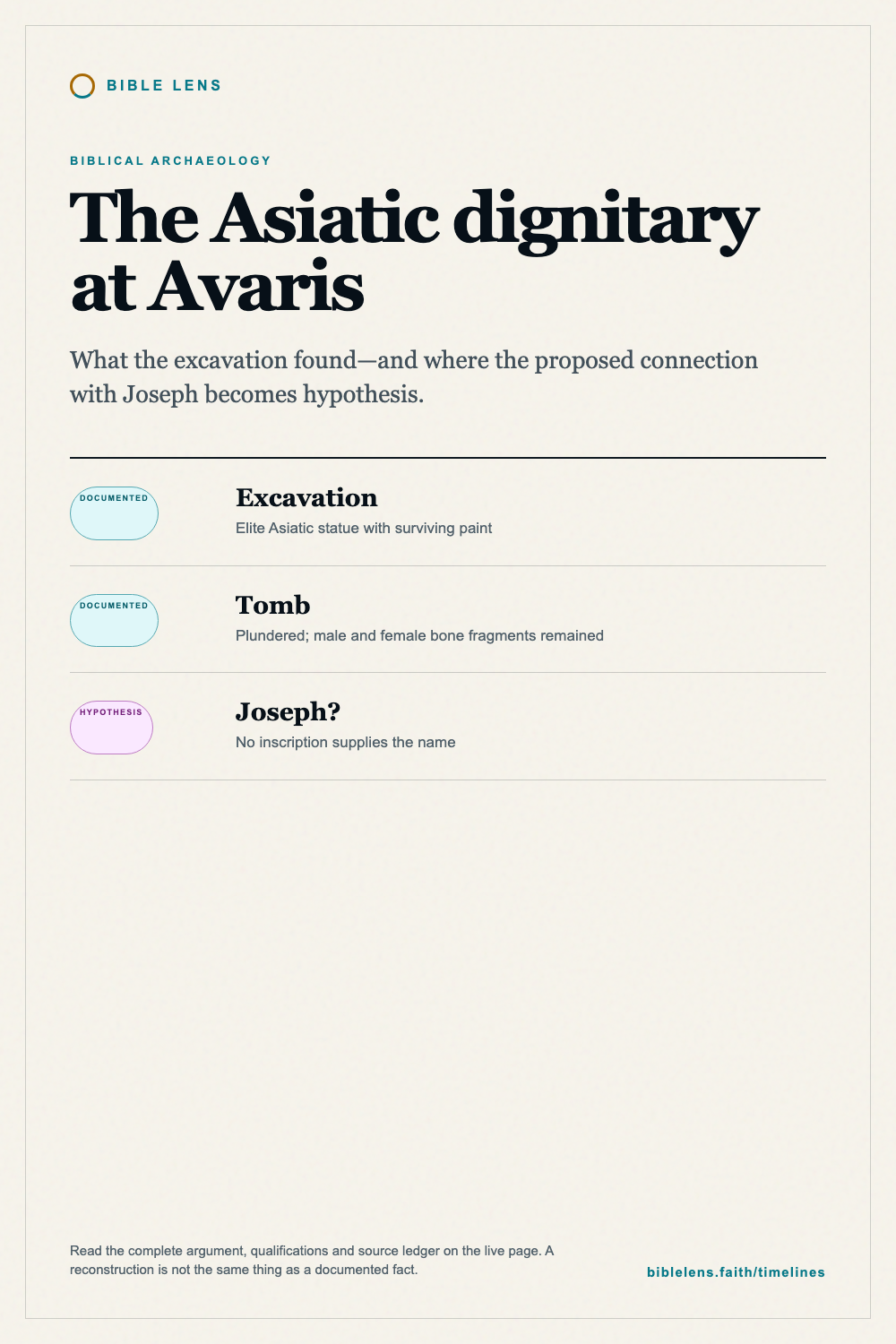
The archaeology is documented. The identification with Joseph is a hypothesis.
At Tell el-Dab'a—ancient Avaris—in Egypt's eastern Nile Delta, excavators found the remains of a large statue representing a high-ranking Asiatic dignitary. Its surviving paint includes yellow skin, reddish-brown hair and a striped garment in red, black and white.
The associated tomb had been plundered, but it was not empty: excavators reported fragments of an adult male and a mature female. No inscription names Joseph. Connecting this foreign official with the Genesis figure is an intriguing minority hypothesis, not the excavation's conclusion.
The reconstructed statue was unusually large and depicted an Asiatic dignitary. Surviving colour included yellow skin, reddish-brown hair and a striped garment. The tomb was heavily plundered; fragments from an adult male and a mature female remained.
The excavation report also cautions that the statue's original location is uncertain. The tomb's superstructure is not securely known; a vaulted chapel is suggested by Middle Kingdom parallels.
Genesis describes a Semite elevated to extraordinary office in Egypt, clothed in distinctive garments and settled in the eastern Delta with his family. Those motifs make the Avaris dignitary an arresting pattern match.
Pattern matching can generate a historical hypothesis, but it cannot provide the missing name. The statue may represent another elite Asiatic in a region where many Levantine people lived.
Genesis 37:3; 41:41–45; 47:6
The tomb should not be described as an intact empty burial with no bones. Nor can the surviving evidence establish twelve principal tombs, an original twelve-column palace plan or a securely identified non-royal pyramid built for this individual.
Those claims ran ahead of the excavation record and have been retired from this investigation.
SOURCE CHECK
This is the line between what the sources say and what the reconstruction proposes.
Its size, iconography and surviving paint identify an elite foreign dignitary.
Sources [1] [2]
Fragments from an adult male and mature female survived despite extensive plundering.
Sources [1]
Red, black and white stripes survive in the statue's painted clothing; linking them to Genesis 37 is interpretive.
Sources [1]
The parallels are circumstantial and no inscription identifies the person.
Sources [1] [3]
The Statue of an Asiatic Dignitary from Tell el-Dabʿa — Robert Schiestl
The excavation-led publication for the statue, tomb context, paint and surviving bone fragments.
Tell el-Dabʿa excavations — Austrian Archaeological Institute
Institutional overview of the site and excavation programme.
Genesis 37:3; 41:41–45; 47:6
The biblical features compared with the archaeological context.
TAKE IT WITH YOU
A portrait summary for saving or sharing. The live page remains the source of record, where qualifications and references stay attached.
Download PNGNew timeline investigations arrive when the source trail is ready.