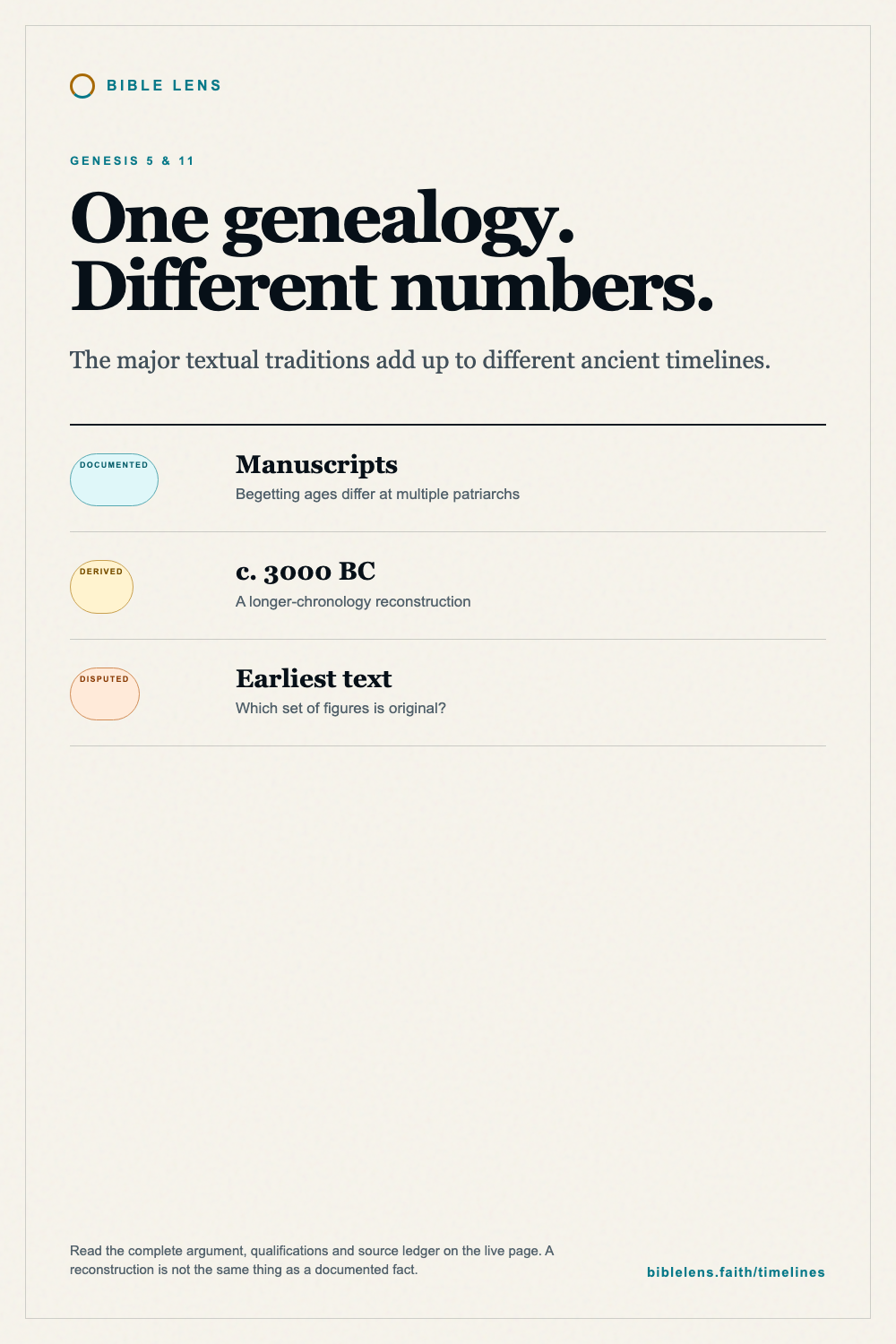
The textual traditions contain different ages
The Masoretic, Septuagint and Samaritan Pentateuch figures diverge at multiple patriarchs in Genesis 5 and 11.
Sources [1] [3] [4]
 BIBLE LENSAncient wisdom, modern clarity
Masoretic chronology
Shorter span
The Hebrew tradition underlying most modern Old Testaments.
Septuagint chronology
+ centuries
Many Greek witnesses add 100 years to several begetting ages.
Genesis 5 and 11
The variants are documented. Their direction and original form are disputed.
The major textual traditions of Genesis do not all give the same begetting ages in chapters 5 and 11. Those differences accumulate into centuries, so any date calculated for the Flood depends partly on which textual chronology is followed.
Using a longer Septuagint chronology can place the Flood around 3000 BC in one Bible Lens reconstruction. That is a derived model, not a date written in Genesis and not proof of the Flood's extent, mechanism or archaeological signature.
Across a series of patriarchs, the Masoretic, Septuagint and Samaritan traditions give different ages for fathering the named son. The totals often preserve the same lifespan while moving years from before the son's birth to after it—or the reverse.
Genesis 5:3–32; 11:10–26
Egypt's Ministry of Tourism and Antiquities dates Djoser's reign to about 2667–2648 BC. A Flood date of 2348 BC would therefore fall centuries after the Step Pyramid was built; a reconstruction around 3000 BC would precede it.
That comparison exposes a chronological tension. It does not establish that either biblical textual tradition is original, nor does the monument by itself test every model of the Flood.
Some textual critics argue that the shorter Masoretic chronology is more likely to be original; others argue that the Greek tradition preserves older figures in key places. The disagreement belongs in the open, because the evidence is real and the reconstruction is consequential.
SOURCE CHECK
This is the line between what the sources say and what the reconstruction proposes.
The Masoretic, Septuagint and Samaritan Pentateuch figures diverge at multiple patriarchs in Genesis 5 and 11.
Sources [1] [3] [4]
A longer chronology plus a chosen historical anchor yields an approximate date; Genesis itself supplies no BC date.
Sources [1] [4]
The official Egyptian chronology dates Djoser's reign to c. 2667–2648 BC.
Sources [2]
Published arguments exist on both sides of the textual history.
Sources [3] [4]
Genesis 5:3–32 and 11:10–26
The primary genealogical figures compared across textual traditions.
The Step Pyramid Complex of Djoser — Egyptian Ministry of Tourism and Antiquities
Official monument page dating Djoser's reign to c. 2667–2648 BC.
A Hasmonean Edition of MT Genesis? — Ronald Hendel
A peer-reviewed argument concerning the chronology's textual development.
The Case for the Septuagint's Chronology in Genesis 5 and 11 — Henry B. Smith Jr.
A published defence of the longer chronology.
TAKE IT WITH YOU
A portrait summary for saving or sharing. The live page remains the source of record, where qualifications and references stay attached.
Download PNGNew timeline investigations arrive when the source trail is ready.